
AI automation and MCP servers
Connect large language models such as Claude and Kimi to corporate data through MCP. Give AI agents controlled access to your 1C and BPM data.
Why off-the-shelf AI struggles with business data
Problems addressed by an MCP-based architecture.
Confidential business data at risk
Sending financial reports or customer databases to public LLM services can conflict with corporate security policies and data protection requirements.
Answers based on outdated information
Without live API access, an LLM may invent inventory levels, prices and order statuses.
Difficult legacy integration
Connecting AI to 1C, SAP or custom ERP systems requires purpose-built interfaces. MCP provides a common protocol for exposing tools and resources.
Missing access controls
A prompt alone does not enforce your role model. A manager could gain access to payroll data or strategy through chat.
Enterprise use cases
AI analyst for 1C and ERP
A manager asks, “Show last month’s margins for the Moscow warehouse.” The MCP server retrieves authorized data from PostgreSQL or 1C and supplies it for a structured answer or chart, without a manual spreadsheet export.

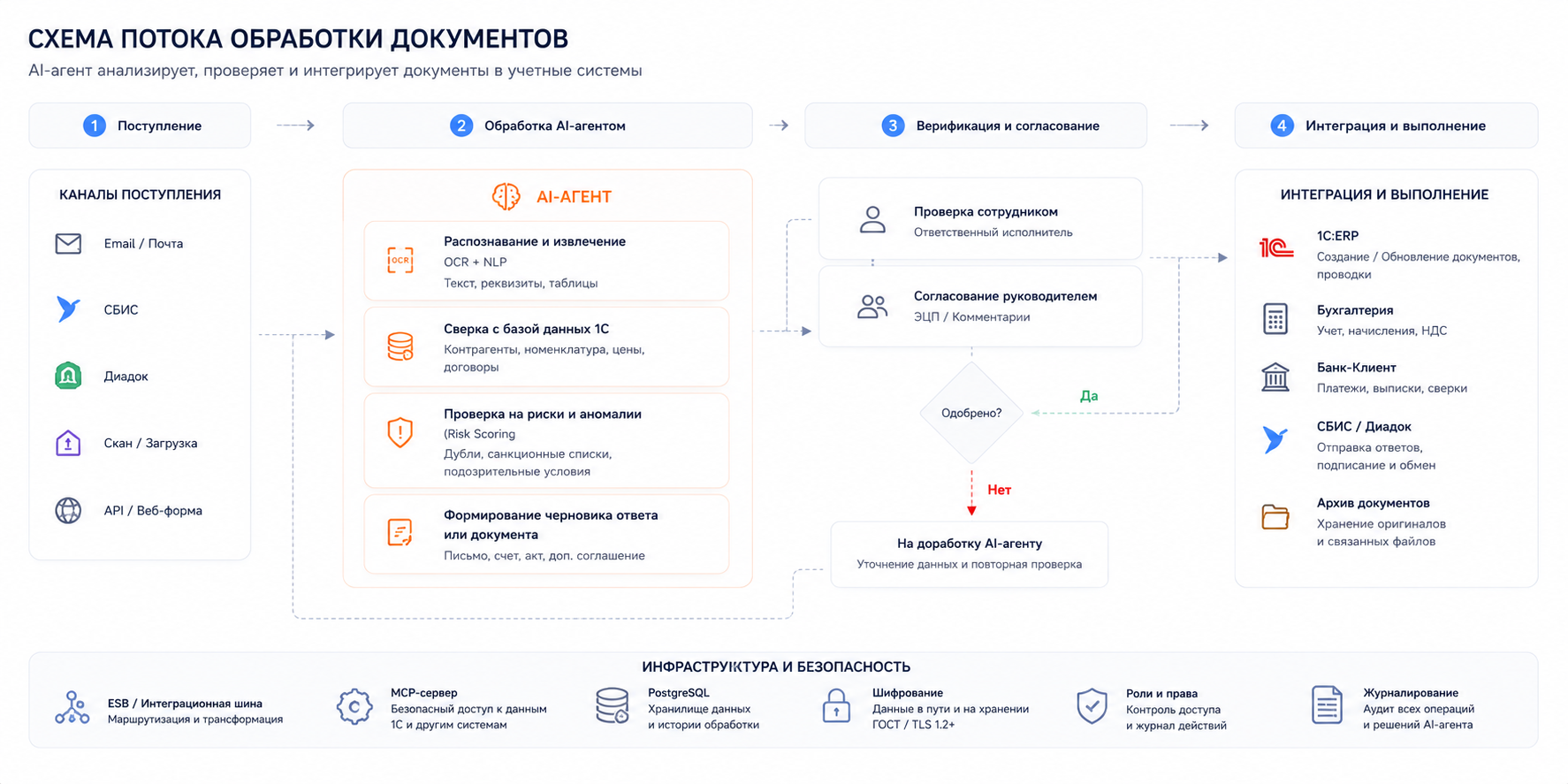
Document workflow automation
An AI agent reviews incoming contracts and invoices, checks details against 1C counterparty records, flags risks and drafts a response. ESB integrations with SBIS and Diadoc connect the document workflow.
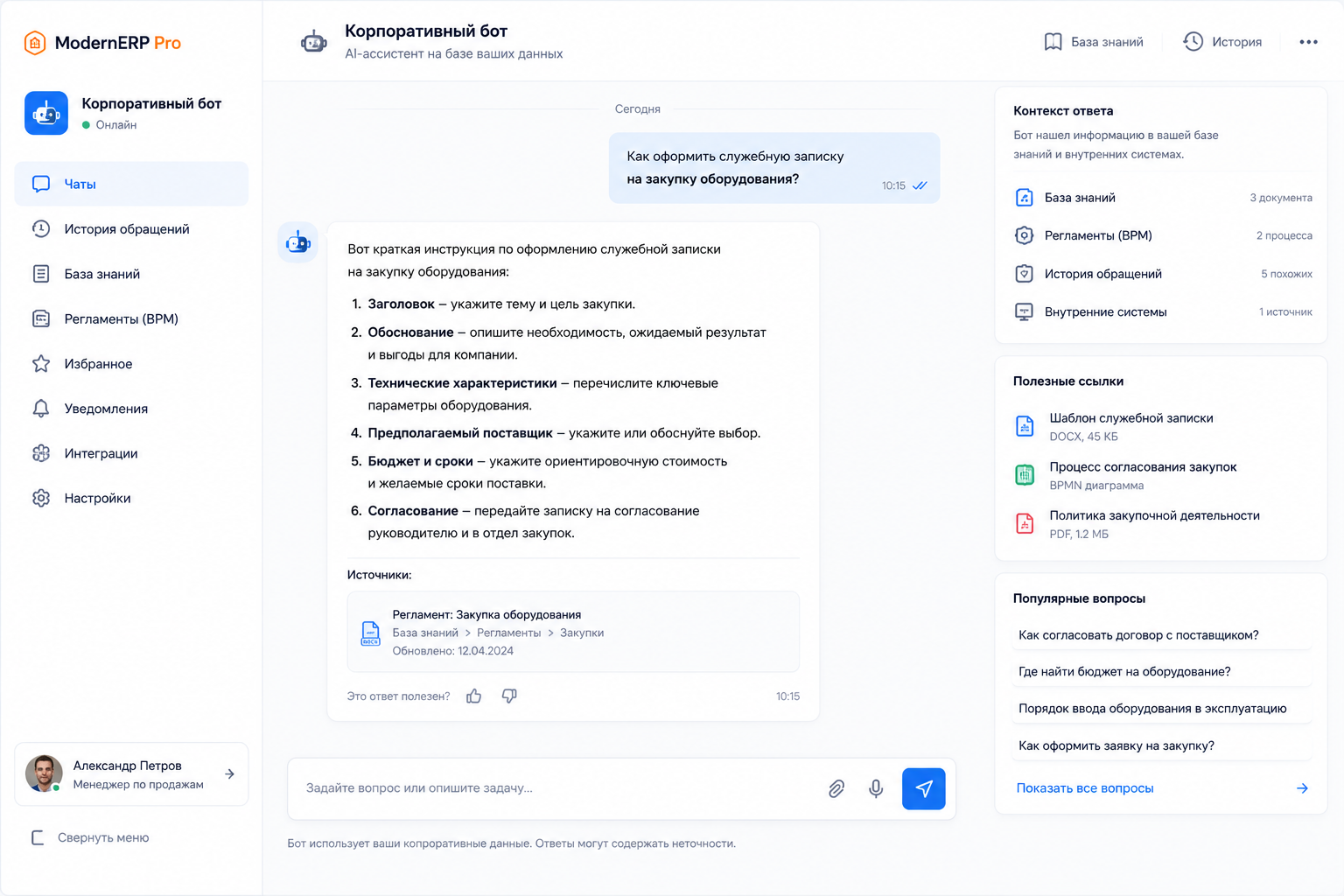
Employee knowledge assistant
A corporate assistant connected to your knowledge base, BPM procedures and ticket history. Answers include source references. Deployment and data access are configured around your security requirements.
AI agent implementation process
From data assessment to production deployment in 3–5 weeks.
Data assessment and MCP design
We define which data AI can access, design MCP tools and resources, and configure role-based permissions.
MCP server development
We build a custom Symfony or Go server connected to your databases and APIs, with request validation and logging.
LLM integration and testing
We connect Claude, GPT or a local model, configure prompts and test answer quality and security against defined scenarios.
Deployment and monitoring
We deploy in your environment, integrate with a corporate messenger or web interface and configure anomaly alerts.
What is MCP, and why does it matter?
Model Context Protocol (MCP) is an open standard for connecting AI applications to tools and data sources. A custom MCP server exposes selected resources and actions from your infrastructure. Access controls, validation and logging are implemented by the server and connected systems so you can control what the AI application can retrieve or change.
Example deliverable: MCP tool configuration
Tool description for an AI agent
This tool retrieves current inventory by warehouse, filters results according to the current user’s permissions and caches frequent requests.
# mcp_tools.yaml — tool definition
tools:
  - name: get_stock_balance
    description: "Get current stock balance for SKU by warehouse"
    inputSchema:
      type: object
      properties:
        sku:
          type: string
          description: "Article number"
        warehouse_id:
          type: integer
          description: "Warehouse ID from 1C"
      required:
        - sku
    handler: StockService::getBalance
    permissions:
      - role: manager
        filter: "warehouse.region == user.region"
Pilot in 2–3 weeks · Fixed price
Frequently asked questions
Is it safe to give AI access to a 1C database through MCP?
The MCP server acts as a gateway. We implement permission checks and action logging, and explicitly define which tables and fields can be retrieved. The information passed to a model depends on the tools, client and deployment you approve.
Do we need powerful infrastructure for an MCP server?
An MCP server is usually lightweight. For a midsize business, a VPS with 2 vCPUs and 4 GB RAM can be sufficient. Requirements depend on the tools and workload; the model may run through a cloud API or on local infrastructure.
Can we use Russian LLMs instead of Claude or GPT?
Yes. MCP is not tied to a particular model. Integration with YandexGPT, GigaChat or locally hosted open-source models such as Llama and Qwen can be implemented through a compatible client or adapter.
How quickly does an AI agent pay for itself?
A typical target is 3–6 months, depending on usage. Savings come from faster information retrieval, routine task automation and fewer data handling errors.